Introduction
Communities in the western US, with assistance from federal, state and local governments, have made important progress over the last 10 years in responding to the rise of catastrophic wildfire. This progress is manifest in improved response capability of firefighting agencies and a network of forest fuel reduction treatments – fire breaks, forest thinning, prescribed fire – across the West.
Despite this progress, the consensus among fire and land managers and scientists is that these efforts must scale-up quickly to alter predicted fire behavior at the scale of the largest wildfires – in ways that protect communities and ecosystems. Efforts to do so are hampered by a variety of factors including gaps in workforce, capacity, and regulatory barriers. But the principal barrier is the high cost of implementation of best management practices including changes in land and forest management, changes in the built environment to reduce flammability and improve public safety, and changes in firefighting response.
This triad of focal strategies was first outlined in the National Cohesive Wildland Fire Management Strategy. Our report focuses on the first of these goals – managing landscape vegetation and fuels – and proposes a new model to manage for wildfire resilience at the appropriate scale – the Million Acre Prototype (MAP). This model is based on learning from EDF’s analysis of very large landscapes in the West that are currently making progress to deliver wildfire resilience through vegetation and fuel management. It identifies best practices in these landscapes and approaches for overcoming persistent barriers.
This report is structured as a brief critique of current practices and recommendations to achieve scaling of these practices to deliver wildfire resilience. This website will provide links to a series of sub-reports that will, when published, provide greater detail on specific elements of the MAP.
Background
Fire scientists, foresters, and fire fighters agree that forest landscapes and communities in the western US can be managed to deliver wildfire resilience and community safety through a carefully designed and implemented program of work. That work will be unique to local landscape and community conditions but will, in general, consist of a custom blend of home hardening, neighborhood planning, fire breaks, forest thinning, and beneficial fire (prescribed, cultural, managed wildfire). When these physical changes in the landscape and community design are coupled with collaboratively pre-planned and data driven fire management, these transformed landscapes will be capable of experiencing wildfire ignitions without those fires becoming catastrophes and increasing the number of acres treated with beneficial fire.
Yet despite billions of dollars in investment and hundreds of millions of person-hours spent by planners, foresters, restoration crews, firefighters and others, no landscapes in the western US are resilient to the risk of catastrophic wildfire at the scale of possible wildfire events – roughly the million-acre scale (hereafter, million-acre landscapes). The current reality is that wildfire resilience is achievable in the West but has not yet been achieved.
But a collective commitment to implementing new models of economically feasible large landscape wildfire resilience management is possible. It will require public/private partnerships on the scale of other large but proven public works projects like interstate highway, flood control projects, and space exploration. Such a commitment will require recognition that up front investments in wildfire resilience will pay off by avoiding massive future wildfire costs. It will require 1) substantial and consistent public funding, 2) commitment to new partnerships with non-federal actors, and 3) building and strengthening innovative institutions built for the purpose of large landscape wildfire resilience.
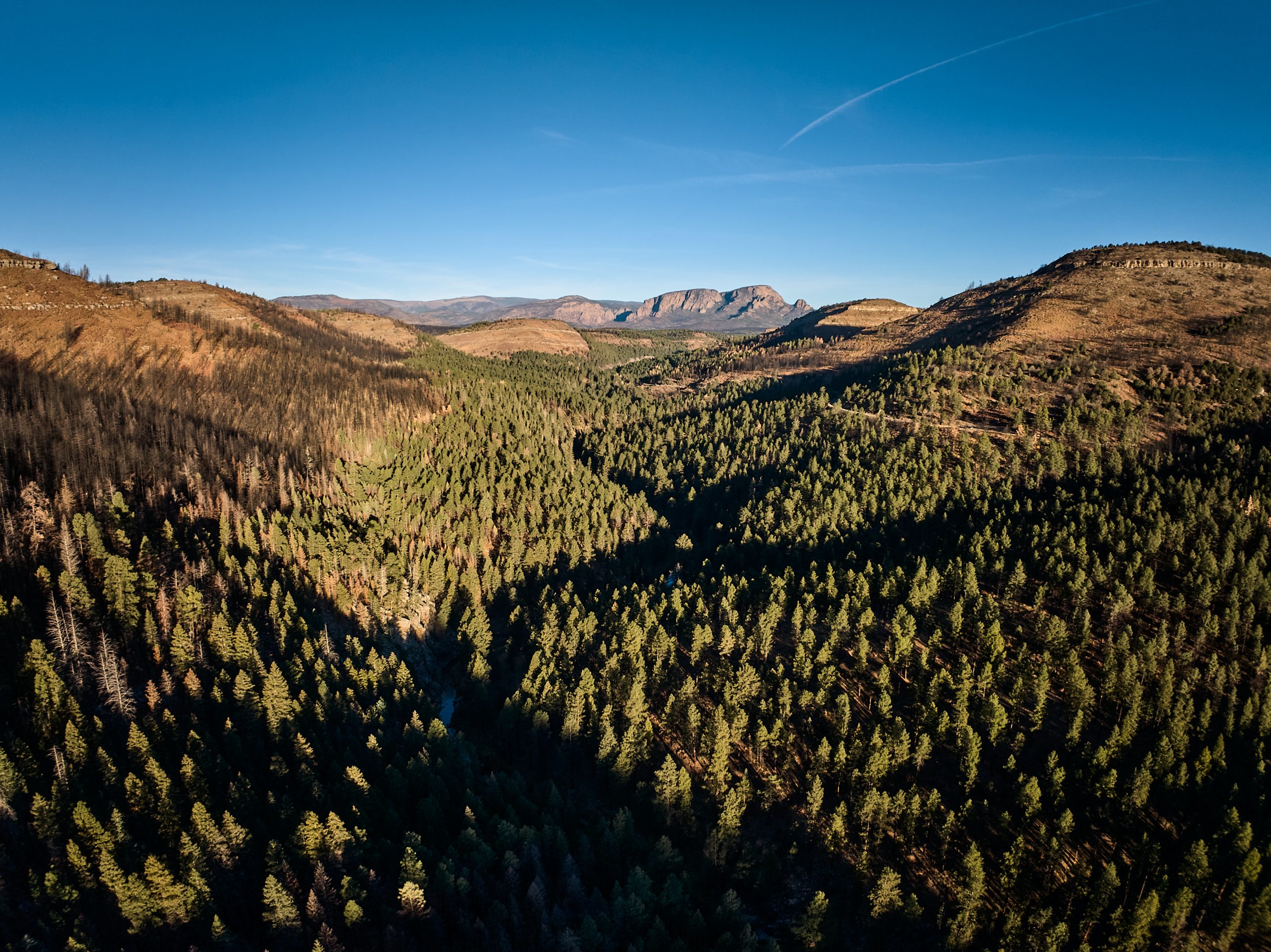
We tailor the recommendations in this report most directly for dry forests and their embedded communities. Scientists define dry forests by their historic frequent fire regimes – those with a historic fire return interval less than 35 years – and represent approximately one third of western US forests. Many of these recommendations will apply to other forest and ecosystem types but specific management guidance will require adjustment to match underlying ecological conditions and dynamics. For example, the relative importance of and specific use case for techniques like prescribed fire, vegetation thinning, and fire breaks will be different in moist or high elevation forest types, grasslands, and chapparal.
Vision
A resilient western landscape will take on different forms in different subregions depending on factors like dominant vegetation types, fuel structure, fire history and population density. But because the majority of forests in the West are adapted to the presence of wildfire historically and because wildfire ignitions are inevitable, a resilient landscape is one where ignitions can occur and wildfire can spread in ways that generally provide ecosystem benefits and where the threat of that wildfire reaching catastrophic intensity and scale is very low.
Resilient landscapes can occur at various scales, but we argue that a meaningful scale at present is about a million acres – the size of the largest fires that have occurred in the past 10 years. It is a scale that, if landscape improvements are implemented and maintained, could meaningfully alter the behavior of potential future wildfires. In this report, we use the phrases large landscape and million-acre landscape interchangeably.
A resilient large landscape will include the following features:
A landscape management plan that identifies and prioritizes needed vegetation treatments (e.g., fire breaks, forest thinning, prescribed fire) and fuel management zones.
A community wildfire protection plan for every population center (e.g., villages, towns) that drills in on treatments in the Wildland Urban Interface (WUI) and plans for more fire-resistant built infrastructure.
Systems, structures, durable financing, workforce, and industrial capacity in place to sustain strong annual progress toward meeting goals of the landscape plan.
Recognition that most treatments will require reentry/maintenance treatments within 10 years of initial treatment, absent the occurrence of natural fire.
Tight coordination exists between vegetation managers, fire response agencies, and community planners to jointly accomplish goals. These critical leaders meet annually before fire season to plan contingencies for wildfire events to take advantage of opportunities for beneficial fire and to ensure community safety.
A key indicator of resilience in this model landscape will be apparent when a wildfire ignites. A resilient landscape and community will have firefighters capable of making quick decisions on how to respond to ignitions. When weather and vegetation conditions are favorable and ignition is far from values at risk, the decision to allow wildfires to burn at low intensity may be appropriate. When they are not, rapid suppression is the best management choice. In short, in a wildfire resilient landscape, the threat of catastrophic fire, smoke exposure, ecosystem harm, and property loss will diminish and hopefully be eliminated.
Critical Gaps
Many authors, agencies, organizations, and commissions have published remedies and recommendations for resolution of the wildfire problem in the western US. We have studied many of these reports; talked to indigenous fire experts, land managers, fire fighters, policy makers, land use planners, policy advocates, and researchers; and visited many western landscapes to learn why heavy investment in wildfire resilience has not yet delivered a sufficient number of resilient landscapes and safe communities.
Our analysis has been centered on high performing landscapes – landscapes that experts agree have made the most relative progress towards wildfire resilience. We concur with many experts that the needs are numerous, complex, and vary by subregion. But our critique of current policy and practice centers on two persistent gaps that, if addressed in new ways, have the potential to catalyze a new generation of landscape resilience efforts and stimulate economic revitalization in the rural West.
Those gaps are:
1. The persistent lack of adequate funding targeted at large landscapes; and
2. The lack of high-capacity coordinating institutions to efficiently deliver results.
The Funding Gap
Restoring wildfire resilience to large western US landscapes is an expensive proposition. Proponents of restoration at this scale in government, community and tribal organizations have been unable to assemble – in any landscape – sustained investment to implement needed land and fire management improvements.
The cost for achieving success will vary widely in each landscape depending on a wide variety of factors that include current vegetation condition, workforce, road access, population density, and many more. For the sake of argument, let’s imagine a theoretical million-acre landscape where experts believe that a combination of thinning, fire breaks, and prescribed fire on 30 percent of the landscape is required to achieve resilience and that it will take 10 years of focused efforts to implement those treatments. Costs of the mix of treatments again vary widely across the West and range from $1000 to $5000 per acre. Assume that the average cost in this landscape is $3000/acre and that we will treat 30,000 acres per year for a total annual cost of $90 million per year or close to $1 billion total over the 10-year program of work.
Covering those costs will require consistent revenue for those organizations and agencies committed to landscape-scale wildfire resilience. The highest performing landscapes in the West have been successful in applying funds from three principal funding categories: government funding; investments by public power and water utilities; and markets. Investments from government sources – both the federal government and state – and power and water utilities have scaled-up over the last five years. Market revenue is highly dependent on local industrial infrastructure and market conditions which, in the West, was weak at the start of the current wildfire crisis and is getting weaker. Achieving landscape- scale success will require increases in funding across the board and policy and practice improvements to deliver results.
Government sources: The federal government pumped new resources into wildfire resilience in 2021 and 2022 through two laws – the Bipartisan Infrastructure Law and the Inflation Reduction Act totaling about $8.5 billion. Most of those funds have been spent or committed and there is no immediate momentum in Congress to reup those investments. California, the epicenter of the costliest recent fires, has invested more than $2 billion since 2020 and is committed to annual investments to meet a million acre per year treatment goal on public and private lands. But in 2026, the state is facing significant budget headwinds due to lower tax revenue and lower revenue from its Greenhouse Gas Reduction Fund. According to resilience practitioners, the durability and consistency of funding are as important as the gross amount. The episodic commitment to wildfire resilience spending creates challenges for maintaining workforce and attracting co-investment from the private sector to sustain progress.
Utility sources: Utilities throughout the West – with revenue from their rate payers – have dramatically increased wildfire-related spending over the last 10 years. This dynamic is most acute in California. For example, Pacific Gas and Electric’s costs for vegetation management in their territory doubled between 2016 and the present representing a quarter of its total expenditures. While substantial, these investments are limited to company-owned lands and transmission corridors and are not currently being applied to the land and forest management needs in the broader landscape. Water utilities in the West are also contributing funds to wildfire resilience efforts at lower funding levels. For example, the Salt River Project in Arizona is committed to helping restore 800,000 acres of forest by 2035 through partnerships with the US Forest Service, the National Forest Foundation, and others.
Market sources: Recovery of costs from sale of commercially valuable by-products – fore example, lumber and bioenergy feedstock – is perhaps the most untapped and most threatened source. Many parts of the West have relatively weak markets for forest byproducts and the closure of several lumber mills and other utilization facilities in Oregon, California, Montana, and Idaho have further limited revenue opportunities. Byproducts are often low-grade materials or species like pine that return less value. Long distances to mills drive up hauling costs and reduce net revenue. Some regions are trying to reverse this trend by siting new production facilities. Tahoe Forest Products is a mill in Carson City Nevada which opened in 2023 in partnership with the Washoe Tribe. Camptonville Community Partnership in Yuba Country, California is building a 5 MW biomass energy plant that is projected to open in 2026. But these new facilities are the exception and industry experts cite the lack of reliable supply of raw materials and workforce constraints as the chief barrier to further expansion.
Together, these sources could begin to approach the levels needed to deliver resilience at the million-acre scale in a handful of landscapes. But that would require an intensive coordination effort and longer-term financial commitments, in much the same way that governments commit to large infrastructure projects. If wildfire resilience projects were treated the same as a public works infrastructure project, planners would develop plans and budgets based on these projections, raise funds, initiate bidding for contractors, secure contracts, and launch full project implementation. But this is not now wildfire resilience is rolling out. Instead, because most of the funding flows from episodically available government grants and unpredictable/opaque agency appropriations, resilience practitioners have generally sought to triage needed treatments and prioritize only the most urgent or easily implemented.
The highest performing landscapes have developed leadership and operating models expert at blending federal and state investment with timber revenue to augment budgets and increase treated acres. In recent years, Rogue Forest Partners in southern Oregon have completed 10% of targeted treatment areas over a period of 10 years with a budget that their leadership estimate was filled with a blend of mostly public grant dollars and some timber revenue, all while maintaining strong support for the treatments among local residents. The North Yuba project in northern California benefited from its designation as a US Forest Service Wildfire Crisis Landscape by the US Forest Service. This status resulted in allocation of over $150 million in additional federal resources that catalyzed development of a large landscape programmatic NEPA permit and siting of a new biomass energy facility that will provide an outlet for small diameter thinning residue and important revenue to augment federal funding.
But a downturn in federal funding for wildfire resilience as BIL and IRA investments expire and lack of clear policy signals from the federal government around the durability of forest products supply have stifled investment and stalled progress toward meeting wildfire resilience goals.
The “Coordinating Institutions” Gap
Wildfire resilience efforts in the West are currently spearheaded by a variety of entities which include tribes, community collaboratives, state forestry agencies, conservation nonprofits, federal land management agencies, and forest products companies, among others. That said, the highest performing landscapes have a common feature – strong leadership and coordination arising from one or a small number of entities that can orchestrate all of the highly complex sequence of actions necessary to plan and implement resilience projects at scale, secure financing, develop long-term contractual arrangements with landowners and land management agencies, attract workforce and industrial capacity, and build social cohesion among the diverse stakeholders.
An example is found in Northeast Washington. The pace and scale of forest restoration on Colville National Forest in northeast Washington state is enabled by tight coordination of multiple strong coordinating entities that provide essential functions for doing ecological forestry at scale. The USFS is aggressively pursuing a twenty-year strategy of planning and restoration for every acre of the 1.5-million-acre national forest, supported by their recently revised Forest Management Plan. This creates a predictability for planning and implementation for key partners, potential buyers of commercial byproducts, and the interested public. Washington State’s Department of Natural Resources provides science support such as landscape evaluations that map ecological needs and a climate-smart trajectory. DNR also collaborates with the USFS on project sales through Good Neighbor Authority, which provides greater flexibility than federal mechanisms and ensures that project revenue is paid forward into additional restoration. Vaagan Brothers Lumber and other contractors bid on projects, the majority of which are through stewardship contracting, which enables essential restoration work, provides timber and other byproducts to nearby mill infrastructure, and pays any leftover revenue from commercial products forward to more restoration on the landscape. DNR is also working with nearby private landowners to ensure that financial and technical assistance is driving restoration on private lands off the national forest. The Confederated Tribes of Colville, the Kalispel Tribe of Indians, and other tribal governments are driving innovative and ambitious Tribal Forest Protection Act projects that enhance work happening on nearby tribal land and help advance indigenous stewardship on the national forest. Work has been further accelerated by “A to Z” projects that integrate third party NEPA into stewardship agreements to get additional projects completed above and beyond Colville National Forest’s normal program of work. This organizational ecosystem is a snapshot of the range of important functions that must be coordinated together for forest restoration that can make an impact for a larger million-acre area.
Many landscapes suffer from less efficient coordination. Constraints include low and inconsistent funding, competition for limited resources, high staff turnover, and lack of agreement on plans and priorities. In many western landscapes, organizations have been forced to specifically tailor the size and complexity of their operations to successfully compete for limited public funding resulting in an ecosystem of small, specialized organizations capable of administering projects and plans at a scale smaller than a million acres. This institutional ecosystem results in the slow accumulation of small-scale projects that may deliver local benefits during a wildfire event, but in aggregate do not improve conditions sufficiently and quickly enough to avoid catastrophic wildfires. Further complexity arises due to the multiple ownerships and differing priorities among the blend of public, private, and tribal land managers in most western landscapes.
During the latter half of the 20th Century, when forest management for timber and water values were preeminent, the US Forest Service filled a large part of the coordination gap in large western landscapes – even as their management approach which included clear cutting, high-grading, and fire exclusion contributed to the current wildfire crisis. Their focus was on managing lands under their control – National Forests – and the high volume of timber management catalyzed the development of workforce, lumber mills, communities, and a host of support businesses. The challenge for the 21st Century will be to recreate this community and economic vitality while shifting the management approach to resilience and restoration and in recognition of the reality that the US Forest Service’s capacity has greatly diminished and is unlikely, in the near-term, to grow.
In practice, funding and coordination are self-reinforcing elements of a functioning wildfire resilience system. Strong coordinating institutions, whether in the private, public, or tribal sectors, tend to be successful in attracting public funding and private sector investment. Strong institutions have advantages in attracting and retaining skilled staff, a critical factor in stewarding long-term funding relationships. Public funding comes with heavy reporting and accountability requirements which in turn demand specialized staff expertise.
With respect to growing market revenue, prospective investors and operators of wood products infrastructure often cite their need for secure, long-term supply agreements with National Forests to unlock investments and construction of new or upgraded processing infrastructure including sawmills, secondary wood products manufacturing (e.g. mass timber, panels), and bioenergy plants. The absence of a strong and clear coordinating entity or small group of tightly linked coordinators with ability and rights to negotiate and deliver administrative fixes such as sustainable and environmentally-beneficial supply agreements remains a key barrier to this type of investment.
Million Acre Prototype (MAP): A Framework to Catalyze Progress
The Million Acre Prototype is an organizing principle intended to help overcome the funding and coordinating institution gaps. MAP is a model based on analysis of best practices for large landscape wildfire resilience implementation in the western US. Its goal is to catalyze changes in policy and investment flows needed to deliver resilience faster than the present rate. We believe that wildfire resilience can be achieved in the western US dry forest landscapes within 10-20 years of intense effort, followed by a lower cost maintenance regime in perpetuity. Put another way, the dominant barriers to resilience lie not in the lack of knowledge of how to manage landscapes but rather in system and organizational flaws that prevent delivery of best practices at scale in targeted landscapes.
To start, we propose that concentrated efforts be made in a few target landscapes where local partners desire a MAP institution to demonstrate to policy makers and the public that success is possible. Special authority and funding could be granted in these MAP proof of concept landscapes to stimulate quick action and efficiently fill key local institutional gaps that are preventing restoration at scale. Lessons will be drawn from these landscapes to inform and catalyze larger systemic policy reforms that will provide wider benefits over time.
In these proof-of-concept landscapes, we are exploring how strong coordinating institutions can be identified or created. Such an institution – a Landscape Resilience Institution (LRI) – would have a mandate to deliver wildfire resilience in the target landscape. It would possess a high degree of management sophistication and credibility with governments, fire agencies, and the restoration industry. It would have a clear governance structure with clear accountability, scope of work, and transparent decision-making. It would possess legal authority and capability on staff to develop landscape resilience plans, raise public and private capital, collaborate with landowners coordinate implementation either through direct action or through subcontracts, and track and monitor progress.
An effective LRI would be well-placed to help tackle the funding gap through a combination of aggressive federal and state grant fundraising and concurrent efforts to diversify revenue from market sources. In some landscapes, revenue from wood products markets is possible related to proximity to facilities that can process and add value to raw materials (e.g. lumber mills, bioenergy plants). Practitioners in other landscapes are contemplating revenue from emerging environmental credit markets including carbon, avoided catastrophic wildfire, and avoided smoke markets. In these, the LRI could be an effective negotiator with the National Forest System and other land managers to initiate long-term, secure supply and crediting agreements.
Effective LRIs can be organizations of several types (e.g. government, nonprofit, industry, tribal) and that a priority should be placed on building effective coordinating capacity, regardless of type. That said, strong consideration should be given to empowering Native American Tribes to play this role in many landscapes. Several Tribes have expressed a desire to play this role in their aboriginal landscapes and are working towards building their staff capacity and skill set in preparation for taking on these responsibilities. As with any organization, up front financial support to help build capacity will be critical. In addition, federal law will need updating to create needed co-management authorities. Tribal co-management of federal lands is a topic of a forthcoming EDF report.
We are also intrigued with the idea of states creating special districts or special purpose entities to fulfill the role of and LRI. The model of a government entity with greater ability to operate independently – much like a port authority or water district – would create conditions potentially conducive to success including authority to raise revenue from fees and municipal or green bonds. Western states have the authority to establish landscape specific Wildfire Resilience Authorities and underwrite the start-up period with dedicated funding resources. We will explore the concept of special wildfire districts in a future report.
In all cases, LRIs must operate in the public trust, with a high degree of transparency and accountability. Future reports will touch on how to bring together effective governance with the vision of public works-scale project planning. There is a strong of public support for beneficial fire use, conservation of old-growth trees and ecosystem function, and community wildfire risk reduction. Delivering these outcomes without returning to timber wars-era gridlock or incentives to overharvest is achievable with thoughtful processes and sideboards.
Priorities for 2026 and 2027
EDF’s priority is to work with partners to establish MAP proof of concept pilots and to promote state and federal policy to support landscape scale wildfire resilience with a focus on overcoming funding and coordination barriers. More specifically, we will:
Study what is working and not working in High Performing Landscapes (HPLs) – HPLs are those landscapes in the West that, against all odds, are slowly delivering landscape resilience success. Where they are finding features and best practice that should proliferate to other regions, we will be working with partners to identify the specific characteristics that lead to success. We will publish our findings and case studies on this website.
Further develop and document best practices with an eye toward capacity building for multiple landscapes – We will write follow on reports and publish them on this website over the coming months and years intended to help build capacity across the West to deliver resilient landscapes. We are currently working on reports addressing tribal co-management best practices and needed policy change as well as a guidebook on ecological forestry practices for dry western forests.
Advocate for policy that support MAP proof of concept – Addressing the wildfire crisis demands durable funding for mitigation and recovery, as well as new programs and authorities. The Fix our Forest Act is currently working its way through Congress and includes elements that will help advance MAP pilots, for example expansion of GNA authorities. Expanding authority for tribes to engage in co-management of National Forests is another priority. We will also be working at the state level to push best practices and innovative policies. We think there are particularly strong opportunities to explore the special district concept in California where substantial wildfire resilience funding is available through the state’s Greenhouse Gas Reduction Fund.